Sound, above all
Instrument maker in Les Rousses
I have been an instrument maker for nearly ten years, between the Jura and Switzerland. I build historical instruments one at a time. What occupies me first is their sound.
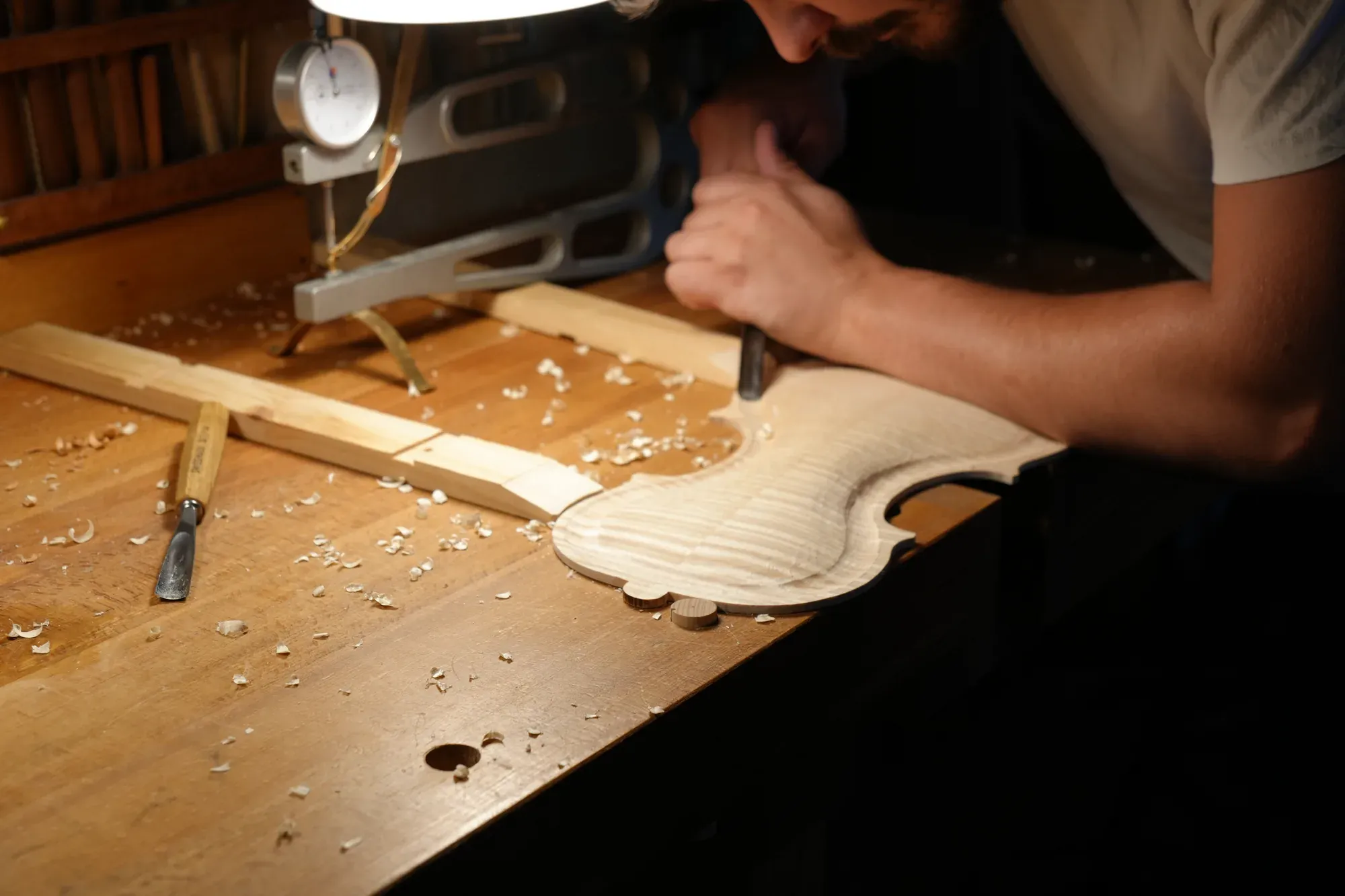
The hands at the gouge, on a figured maple back
Wood came first
Wood came before everything else. I have worked it since I was very young, in a family where there was never a shortage of shavings: my father turns wood, my godfather is a cabinetmaker, my uncle a joiner. I went on to study mechatronic engineering. I worked on the manufacture of titanium medical prostheses, where I studied vibration mechanics closely. That is when I took up the violin.
The question
A historical instrument has nothing of an electric guitar. Its amplification is entirely natural: wood, air, strings under tension. And yet it carries to the back of a hall. How? And what makes an instrument, in the end, sound well? That question never left me. It is what led me to instrument making.
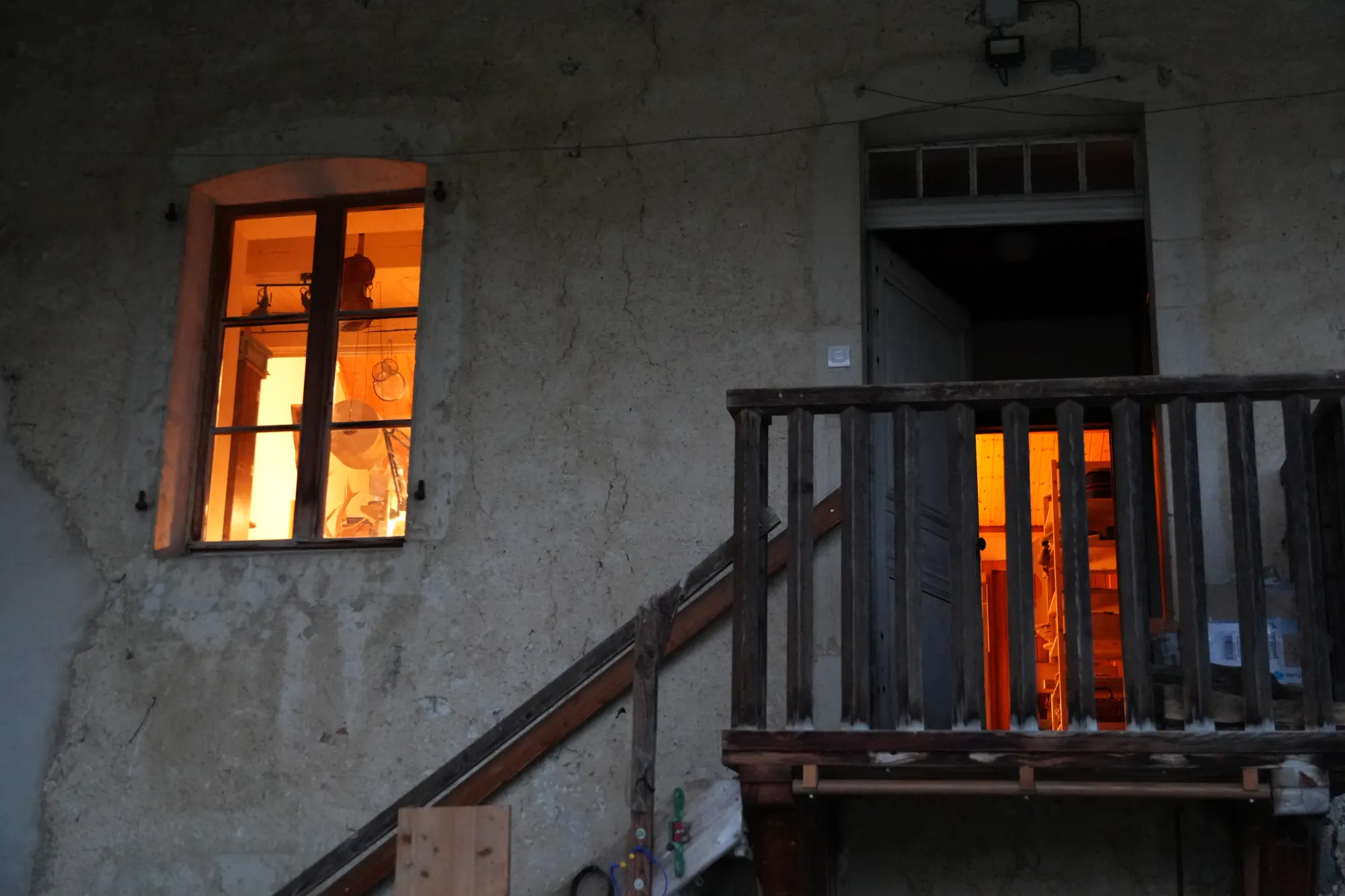
The entrance to the workshop
Master to apprentice
I began with the distance courses of Peter Westerlund, a Swedish maker. I studied his research thoroughly, on the dimensioning of soundboards and arched backs of bowed string instruments. That research led me to Luc Breton, in Switzerland. It was at his bench that I learned most of what I know today, in the manner of an old-style compagnonnage, a master to pupil tradition that is now rare, and has all but disappeared in France.
A family workshop
The workshop carries our name, because it is a family workshop. My father works here with me. He has made a speciality of everything shaped on the lathe, the pegs, the end buttons. And he builds instruments too.
Sound
For the ancients, the first nature of an instrument was to sound, and to imitate the human voice. The idea comes from far away, from civilisations long gone. Players of traditional music, Romanian, Chinese, Egyptian, are in fact often struck by the sound of these instruments now called “baroque”.
The gesture
The work rests on the traces left by the old masters, and on the way they worked. I study the instruments that come into my hands, some five or six centuries old, and I look for the proportions hidden in them. Behind them, often, lies the art of the line. That edifice of rules served the architect, the stonemason and the cabinetmaker as much as the instrument maker. I try to understand its principles. Then I fit gut strings, as has been done for more than two thousand years.
The aim is to recover, as faithfully as possible, the way these instruments were built several centuries ago, and they find their place in baroque, classical, contemporary or traditional music.
Nicolas Wicky, instrument maker
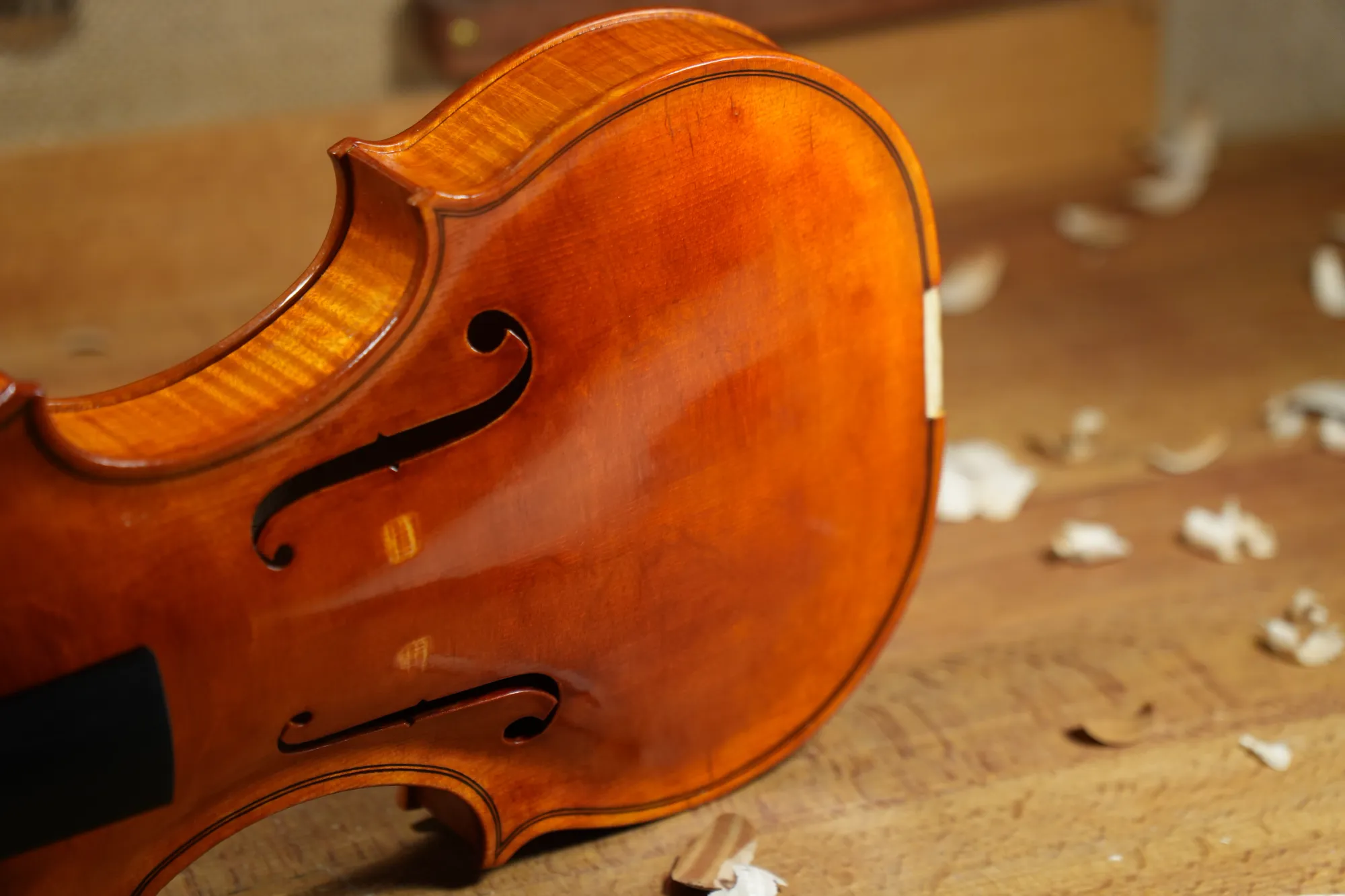
The f-holes and varnish of a violin, on the bench
The aim
A setting in Les Rousses, in the Jura, a few kilometres from the Risoux and its tonewood. A workshop, with a school attached to it.
Tomorrow
This compagnonnage, I would like to pass on in my turn. First through a non-profit instrument making school. And perhaps, one day, through a music school.
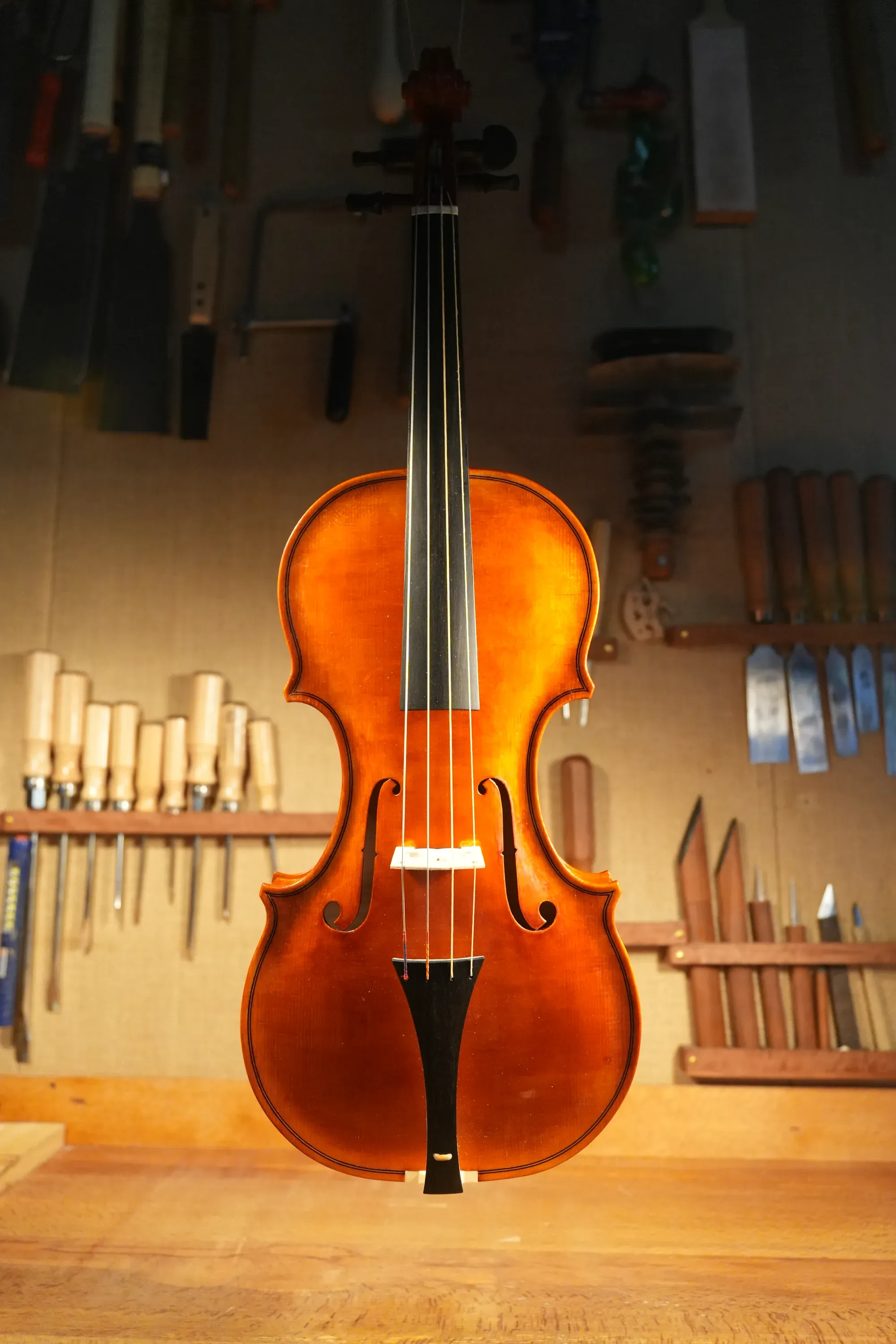
A finished violin, in front of the tool wall
Every instrument
Violin, viola, cello, and rarer instruments, such as the viola da gamba or the lute. I build them one by one, at the bench.